
Let's start with what's really happening
Desire mismatch is the most common sexual complaint I hear from couples. Not erectile dysfunction, not pain, not weird fetishes. One person wants sex, the other doesn't. Or they want it at different frequencies, with different intensity, at different times of day. And both people end up feeling broken.
Here's the uncomfortable part. Neither of you is broken. And the solution isn't for one person to just want more (or less) sex.
Why desire mismatch isn't about willpower or love
So much of the advice out there assumes desire is a choice. "Just set the mood," they say. "Try lingerie," they say. "Schedule sex," they say. Some of that lands. But if the fundamental desire frequency is different, you can't schedule yourself into alignment.
Desire is shaped by at least five things happening at once. Stress load. Sleep quality. How seen you feel by your partner. Whether you're in a task mindset or a pleasure mindset. And honestly, what was modeled for you growing up about sex and intimacy. If one of you grew up in a household where sex was abundant and celebrated, and the other grew up where it was scarcity, you're starting from wildly different baselines. That's not fixable with mood lighting.
The couples who navigate this best aren't the ones who achieve perfect frequency matching. They're the ones who stop trying to change each other's baseline desire and start asking a different question: How do we both get what we need without resentment?
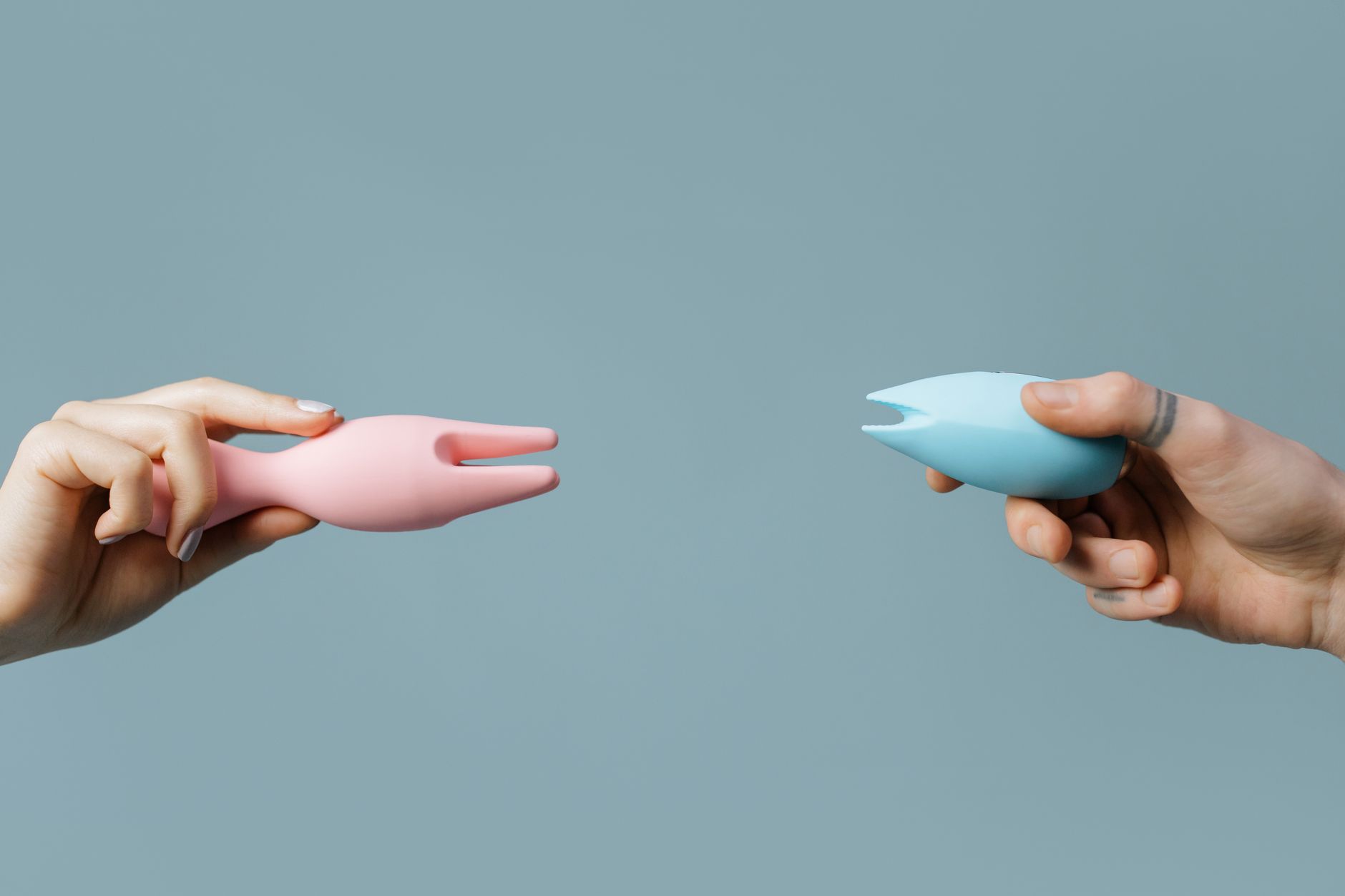
Photo by cottonbro studio on Pexels
Where a lemon vibrator actually enters the picture
Let's say you're the partner with higher desire. You want sex. Your partner doesn't, or not tonight, or not with the frequency you'd prefer. The old narrative is: you either wait, feel rejected, and simmer in resentment. Or you pressure your partner, they feel obligated, and it's not good for anyone.
A lemon clitoral vibrator changes that equation. It gives you a legitimate way to access pleasure that doesn't depend on your partner's desire matching yours in that moment. And here's what matters. When you're able to touch yourself with a tool designed for actual pleasure (not just a callback to partnered sex), something shifts psychologically. You're not waiting for permission. You're not negotiating. You're taking care of yourself.
For the lower-desire partner, this is also valuable. You're not the only gatekeeper of sex and intimacy anymore. You're not responsible for meeting all of your partner's sexual needs. That pressure lifts, which actually often makes you want sex more.
How to talk about this without it feeling like rejection
Here's the scaffolding that actually works. First, separate the conversation about desire mismatch from the conversation about solo pleasure. These are not the same thing, and treating them as the same thing is where everything falls apart.
Desire mismatch is real and needs its own discussion: "I notice we want sex at different frequencies, and I want to figure out how we both feel good about that." Solo pleasure with a lemon vibrator is a parallel channel, not a replacement: "I want to take care of myself in ways that feel good to me, and I want you to feel good about that happening." These conversations happen separately, and neither one is a negotiation about the other.
Many couples try to solve desire mismatch by adding toys, thinking the novelty will rev up the lower-desire partner. Sometimes it does. Usually, if the fundamental desire frequency hasn't shifted, toys just get awkward. A lemon clitoral vibrator works differently. It's not about performing desire matching. It's about making sure both partners have a pathway to pleasure that doesn't depend on the other person's baseline.
The practical choreography
If you're the higher-desire partner and your partner isn't in the mood.
Don't make it their job to watch. Don't make it a show. Use your vibrator the way they use the shower. It's just something you do. Maybe they're reading next to you, maybe they're in another room. Maybe later they ask about it, maybe they don't. Honestly, most people appreciate knowing their partner is taking care of their own pleasure and not resenting them for not matching their frequency.
If you want your partner involved sometimes: "I'd love to touch you tonight, and I'd also love to use my vibrator. Would you want to be here while that happens?" That's an invitation, not a demand. If they say no, you still get to say yes to yourself.
If you're the lower-desire partner and you feel guilty: don't. Your partner's pleasure is not your responsibility. Full stop. You can support it, celebrate it, be present for it sometimes. But you cannot manufacture desire you don't have, and both of you will suffer if you try.
What changes when desire mismatch isn't a battle
I've worked with couples for years. The ones whose relationships survive and actually improve after hitting a desire mismatch are the ones who stop trying to win and start problem-solving together. The resentment that kills relationships isn't about the mismatch itself. It's about the feeling that someone is trying to change you, control you, or make you wrong for your baseline desire.
When the higher-desire partner gives themselves permission to take care of their pleasure independently, something interesting happens. Pressure lifts. Connection feels easier. And weirdly, the lower-desire partner often finds they want sex more frequently, not because they've been convinced, but because sex isn't loaded with all that resentment anymore.
A lemon clitoral vibrator isn't a magic fix. But it does help you stop using your body as a hostage in a negotiation. Your pleasure matters independently of whether your partner wants you in that moment.
When desire mismatch is masking something else
Sometimes what looks like desire mismatch is actually something deeper. Your partner stopped wanting sex after you got married. Or their desire dropped when you had kids. Or they seem interested in sex with someone else but not you. That's different. That's a signal that something else is broken in the relationship or in how you're connecting.
A lemon vibrator won't fix emotional disconnection or infidelity or a fundamental incompatibility. Those things need actual couples work. Therapy. Honest conversation about what changed and why.
But if the mismatch is simply baseline frequency difference and not tied to resentment or disconnection? A vibrator is genuinely helpful. It's a tool that says: "Your pleasure matters. My pleasure matters. We don't have to achieve perfect alignment for both of us to feel good."
FAQ: Desire mismatch and solo pleasure
Will using a vibrator make my partner feel inadequate or replaced?
It depends entirely on how you frame it. If your partner perceives the vibrator as a judgment ("You're not enough"), they'll feel replaced. If you frame it as "I enjoy taking care of myself and I want you to feel comfortable with that," and you mean it, then most partners can hear it. The key is genuinely separating your solo pleasure from your relationship pleasure. They're not competing. You're not shopping around.
Is it normal to want sex way more often than my partner?
Completely normal. Desire frequency varies wildly from person to person and isn't correlated with love or commitment. You can be madly in love with someone and want sex every other day while they want it twice a month. That's just two different baseline nervous systems. Not a problem to fix. A difference to respect.
What if my partner finds out I'm using a vibrator and gets upset?
Then you have a conversation that goes deeper than the vibrator. Their reaction is worth exploring. Are they afraid you'll leave them? Do they have shame about sex? Were they taught that solo pleasure is cheating or wrong? Understanding the root makes the actual issue visible. Often the vibrator isn't the problem. It's just where the discomfort surfaces.
Should we use a vibrator together if we have desire mismatch?
Maybe. But don't start there. Solo pleasure is easier to navigate than partnered pleasure with an audience because there's no performance pressure. Once you're both comfortable with the vibrator existing in your sex life independently, partnered use can be a nice addition. But it's not the solution to desire mismatch.
How do I bring this up without sounding like I'm criticizing my partner's desire level?
Start with yourself, not them. "I've been thinking about my own pleasure and realizing I want to take better care of myself. I'm considering getting a vibrator, and I wanted you to hear that from me first." You're not saying they're not enough. You're saying you want to be more attentive to what you need. That's actually attractive to most partners.
Can a vibrator actually improve our sex life if we have mismatched desire?
It can help, but only if the foundation is there. If you're using a vibrator to patch over resentment or disconnection, it won't work. If you're using it to free yourselves from the pressure of perfect frequency matching, it can actually help you both feel better. The vibrator is a tool, not a therapist.
The real shift
Desire mismatch stops being a crisis when both people accept that they might not align perfectly, and that's okay. A lemon clitoral vibrator is just permission in silicon form. Permission to care about your own pleasure. Permission to stop waiting. Permission to be okay with being different.
The couples who navigate this best aren't the ones with matching desire. They're the ones who stopped trying to fix each other and started asking: "How do we both feel cared for?" Sometimes that means sex together. Sometimes that means solo pleasure while your partner reads nearby. Sometimes it means recognizing that you have fundamentally different needs and being honest about what that means for the relationship.
But you can't answer that question if you're still stuck in the framework that there's something wrong with one of you. There isn't. You're just different. And that's actually workable.